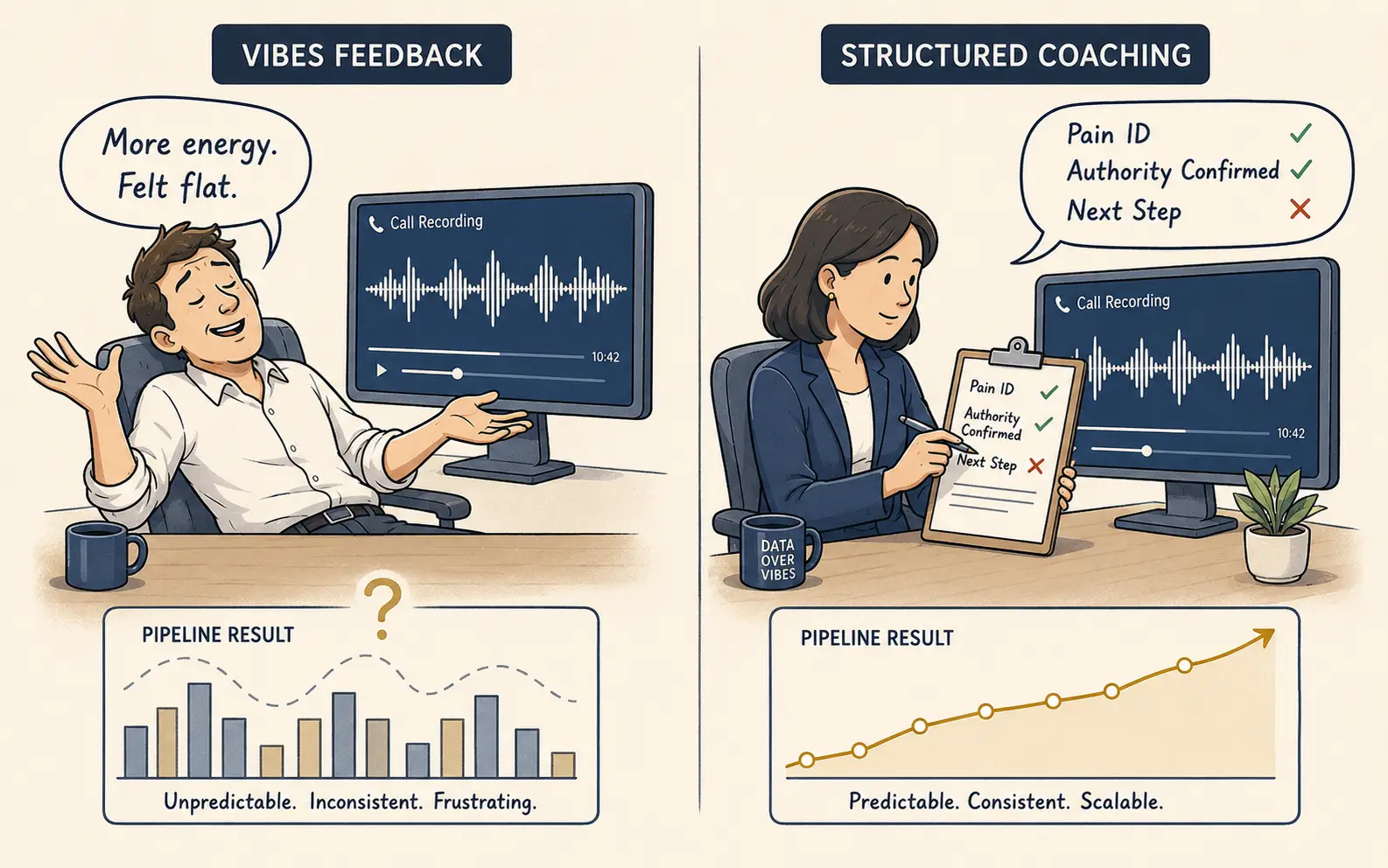
When SDR coaching and call scoring are tied to objective standards, improvement becomes measurable.
And measurable improvement compounds.
The Problem with “Style-Based” Coaching
Style-based coaching focuses on personality instead of performance.
Energy matters. Rapport matters. But without structure, those elements are inconsistent predictors of pipeline contribution.
A rep can sound confident and still fail to uncover real pain. Another rep might be quieter but qualify more effectively.
A disciplined sales quality assurance process evaluates what moves opportunities forward, not what sounds impressive.
Because revenue does not respond to tone alone.
What Objective SDR Coaching and Call Scoring Looks Like
Objective SDR coaching and call scoring evaluate behaviors tied directly to outcomes.
For example:
Did the rep confirm buyer authority? • Was the primary pain point clearly identified? • Did the rep quantify impact where possible? • Were objections handled using a defined framework? • Was a concrete next step secured?
These criteria transform call reviews from opinion sessions into performance diagnostics.
The shift is subtle, but the impact is significant.
When coaching is objective, reps improve faster. Leaders identify trends earlier. Forecasts stabilize.
How Quality Assurance Reduces Pipeline Risk
Forecast volatility rarely begins at the closing stage. It usually begins at qualification.
If early conversations lack structure, downstream opportunities are fragile.
A structured sales quality assurance process strengthens early-stage discipline, which improves:
Quality assurance is not about catching mistakes. It is about engineering consistency.
Consistency drives predictable pipeline growth.
Integrating Quality Assurance with KPIs
Call scoring should not operate independently from performance metrics.
Outbound KPI scorecards identify where conversion fluctuates. SDR coaching and call scoring explain why.
For example:
If meeting-to-opportunity conversion drops, call reviews may reveal weak qualification. If connect rates are strong but progression stalls, objection handling may require refinement.
When quality assurance integrates with data, improvement becomes systematic.
That is the difference between coaching and calibration.
Signs Your Call Reviews Are Too Subjective
If you notice:
Reps receiving conflicting feedback • Improvement that depends on the manager reviewing • High performance variability across the team • Forecast surprises despite strong activity
Your sales quality assurance process likely lacks defined scoring criteria.
Coaching without structure feels supportive.
It just doesn’t scale.
Building a Structured Quality Assurance Framework
Step one: Define the core objectives of each call type.
Step two: Translate those objectives into observable behaviors.
Step three: Score calls against defined criteria, not personality preferences.
Step four: Align coaching conversations directly to scorecard findings.
When SDR coaching and call scoring operate within a disciplined framework, performance becomes repeatable.
A sales quality assurance process is a structured framework for objectively reviewing and scoring sales calls to improve consistency and performance.
How does SDR coaching and call scoring improve pipeline?
By tying coaching to defined behaviors and measurable outcomes, teams reduce variability and improve conversion quality.
Should call reviews focus on tone and personality?
Tone and rapport matter, but they should not replace objective qualification and discovery benchmarks.
How often should call reviews occur?
High-performing teams review calls weekly, integrating findings into coaching and KPI tracking.
Sales Quality Assurance Process
Most teams think they are coaching.
In reality, they are commenting.
A structured sales quality assurance process turns feedback into performance leverage. SDR coaching and call scoring become objective, measurable, and aligned to revenue outcomes.
Lead Catalyst builds outbound systems where quality assurance strengthens qualification, reduces variance, and stabilizes forecasting.
Because pipeline consistency is not accidental. It is engineered.