Data-driven outbound sales is the difference between guessing why pipeline stalled and knowing exactly where it broke.
Most teams feel conversion issues before they can explain them. Meetings drop. Opportunities thin out. Forecast confidence weakens. The instinct is usually to increase activity or adjust messaging.
But without diagnostic clarity, those changes are reactive.
A disciplined pipeline generation system doesn’t ask, “How do we work harder?” It asks, “Where exactly is conversion leaking?”
That question changes everything.
Why Conversion Breakdowns Go Undetected
Outbound rarely collapses all at once. It erodes. Connect rates dip slightly. Qualification softens. Meeting quality varies. Sales cycles stretch.
Because most teams measure volume instead of stage-by-stage conversion, early signals get missed.
When leadership tracks only top-line numbers, breakdowns hide in the middle of the funnel. By the time revenue impact is visible, the root cause is several stages upstream.
Data-driven outbound sales prevents that lag.
It isolates the exact point where momentum weakens.
The Three Most Common Conversion Leaks
A strong pipeline generation system evaluates conversion between every stage. In practice, most breakdowns fall into one of three categories.
1. Targeting Misalignment
If connect rates are healthy but qualified conversation rates are inconsistent, the issue is often ICP precision.
You’re speaking to people. They’re just not the right people. No amount of scripting fixes segmentation.
2. Discovery Depth
If meetings are booked but few convert into sales-accepted opportunities, discovery is likely shallow.
Reps may be polite and prepared, yet fail to uncover measurable pain or decision authority.
Data-driven outbound sales flags this quickly because it tracks conversion by stage, not just total meetings.
3. Objection Handling Variability
If opportunity progression fluctuates heavily between reps, objection management may lack structure.
Some reps navigate resistance effectively. Others retreat too early.
A mature pipeline generation system measures performance consistency across the team, not just aggregate numbers.
Variance reveals weakness.
How Data-Driven Outbound Sales Creates Diagnostic Clarity
The goal of data-driven outbound sales is not to produce more dashboards. It is to create actionable visibility.
At minimum, you should track:
Connect rate by segment
Qualified conversation rate
Meeting-to-opportunity conversion
Opportunity-to-close ratio
Time between stages
When these metrics are segmented by industry, rep, and campaign, patterns emerge quickly.
If conversion drops only in one vertical, targeting may be off. If it drops across all segments, messaging or qualification likely needs refinement.
This is how a pipeline generation system shifts leadership from reaction to precision.
When performance dips, many teams default to increasing volume.
More calls, emails, and sequences. Activity creates the illusion of control.
But if the leak lives in qualification or targeting, volume only accelerates inefficiency. Data-driven outbound sales resists that impulse. It diagnoses before it scales.
Because scaling a flawed stage multiplies the flaw.
Integrating Diagnostics into Coaching
Once conversion breakdowns are identified, improvement must be systematic.
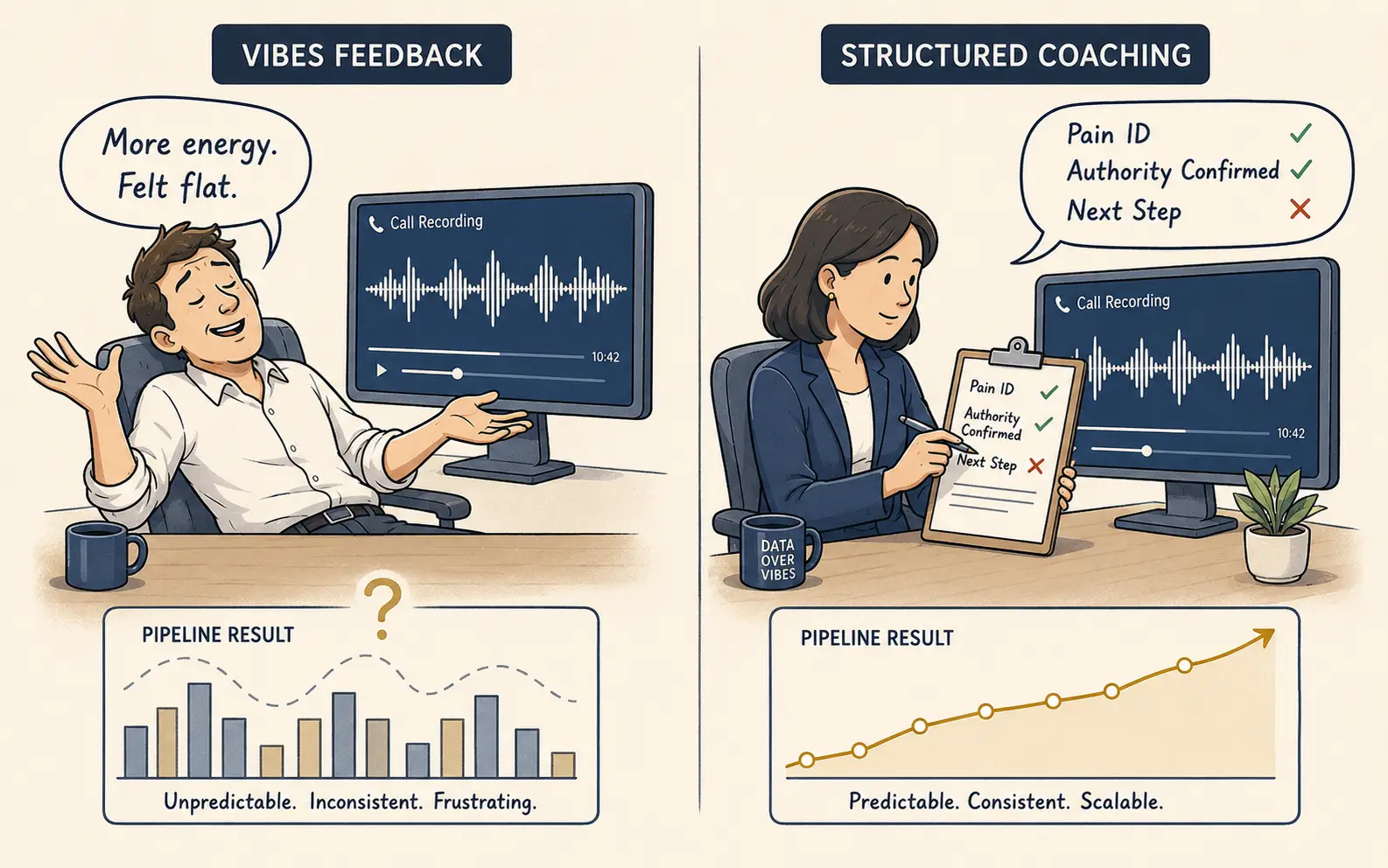
If qualified conversation rates decline, coaching should focus on discovery frameworks. If meeting-to-opportunity conversion drops, call scoring should emphasize authority confirmation and pain quantification.
The pipeline generation system and coaching structure must work together.
Metrics reveal where. Quality assurance reveals why. Together, they stabilize performance.
The Impact on Predictability
Predictability does not come from optimism. It comes from reduced variance.
When conversion rates are measured stage by stage:
Forecast confidence improves
Rep variability decreases
Resource allocation becomes more accurate
Revenue projections stabilize
Data-driven outbound sales transforms pipeline from a hopeful estimate into a managed system.
The difference is subtle in language. It is significant in results.
Signs You’re Managing Without Diagnostics
If you experience:
Sudden pipeline shortfalls
Inconsistent opportunity creation
Frequent forecast revisions
Difficulty identifying root causes
Your outbound engine likely lacks structured diagnostics.
A pipeline generation system should predict problems before they surface in revenue.
If it only reports them afterward, it is incomplete.
Frequently Asked Questions
What is data-driven outbound sales?
Data-driven outbound sales is a structured approach that uses stage-level conversion metrics to diagnose and optimize outbound performance.
How does a pipeline generation system improve conversion?
By tracking conversion between each stage, it identifies breakdowns early and allows teams to refine targeting, messaging, or qualification systematically.
What metrics matter most in diagnosing conversion issues?
Connect rate, qualified conversation rate, meeting-to-opportunity conversion, and opportunity-to-close ratio are key indicators.
Should volume increase when conversion drops?
Not immediately. Diagnostics should identify the root cause before scaling activity.
Your Sales Experts
Conversion rarely fails without warning. It drifts and weakens. It signals.
Data-driven outbound sales gives you the visibility to catch those signals early. A disciplined pipeline generation system turns breakdowns into refinements instead of surprises.
Lead Catalyst builds outbound infrastructures where performance is measured, diagnosed, and engineered.